





|
Индия захватывает открытие торговых возможностей в Афганистане на фоне разрыва в Пакистане
|
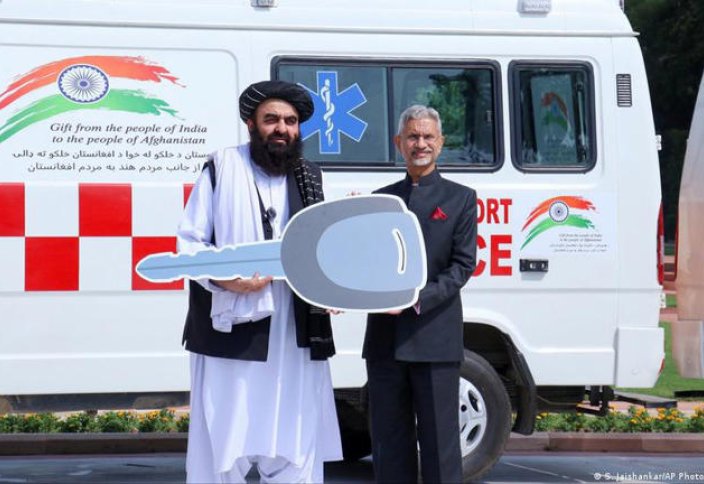
Пакистано-афганский кризис и закрытие границ меняют региональную торговлю. Индия использует конфликт, углубляя экономические связи и стратегическое взаимодействие с Кабулом.
Отношения между Пакистаном и Афганистаном достигли исторического минимума в последние месяцы после смертельных трансграничных столкновений, в результате которых погибло десятки человек.
Важные торговые пути, такие как Торкхам и Чаман, с тех пор были закрыты. Это парализовало торговлю, резко подняло цены и углубило разрыв.
Закрытие пограничных переходов Пакистана с Афганистаном также вызвало значительную перестройку региональных торговых моделей, при этом Индия стала основным бенефициаром.
Кризис на границе между Пакистаном и Афганистаном меняет региональную торговлю
Конфликт между Пакистаном и Афганистаном привёл к сокращению торговли между двумя соседями почти вдвое.
Двусторонняя торговля выросла на 25% в финансовом году 2024-25, достигнув почти 2 миллиардов долларов (1,88 миллиарда евро), согласно многочисленным сообщениям СМИ обеих стран.
Но из-за закрытия границ и военной напряжённости сумма снизилась примерно до 1 миллиарда долларов, сообщил Хан Джан Алокозай, член совета Торговой палаты Афганистана, в интервью Amu TV. Это огромный ущерб для страны, экспорт которой составил $992 миллиона, а экспорт в 2022 году составил $5,76 миллиарда, согласно данным Всемирной торговой организации (ВТО).
Афганистан поворачивается в сторону Индии
With this critical commercial relationship severely disrupted, Afghanistan — largely shunned by the international community since the Taliban returned to power — is actively seeking alternative trade routes.
Afghan Commerce Minister Nooruddin Azizi recently traveled to New Delhi to negotiate expanded economic ties, including increased cargo flights to Kabul from Indian cities like Delhi, Amritsar, and Mumbai. Both sides also appointed trade attachés to their respective embassies to oversee and facilitate bilateral commerce.
The discussions focused on tariff reductions, tax exemptions and a bilateral trade target of $1 billion, signalling Afghanistan's intent to fundamentally restructure its commercial relationships away from Pakistani ports and border crossings.
Чабахар, стратегические ворота Индии
Central to India's approach is Chabahar port in Iran, which provides landlocked Afghanistan with access to international waters — without having to cross Pakistani territory.
India is investing heavily in the port, which serves as a pivotal sea route that bypasses Pakistan, facilitating essential imports for Afghanistan.
Since relations between Pakistan and Afghanistan soured, Afghan traders have been shifting to use the port to import food, commodities, construction materials and consumer goods, essentials that previously came through Pakistan.
"While the blockade continues, India must prioritize Chabahar port upgrades, which include container handling, storage and hinterland connectivity covering Chabahar-Zahedan rail, dry ports and faster customs," Ajay Bisaria, a former envoy to Pakistan, told DW.
The recent US sanctions waiver granted in October for operations at Chabahar — which India is developing and expanding — removes a major constraint that had previously limited the port's commercial viability.
"India must also leverage the US sanction waiver on Chabahar to offer speed and reliability advantages to counter Pakistan's cheaper routes. India's proactive measures of subsidies, digital clearance, logistics integration can ensure competitiveness even when the blockade lifts," added Bisaria, pointing out that the challenge is to move fast enough to create infrastructure and economic ties that make its routes competitive.
Gautam Mukhopadhaya, a former ambassador to Afghanistan, also said the current Afghanistan-Pakistan blockade, however severe, presents India with a strategic opportunity.
"If alternative routes through Chabahar Port can be normalized and made commercially viable, they could establish a sustainable bypass to Pakistan's unpredictable transit policies," Mukhopadhaya told DW.
He emphasized that the conflict between Islamabad and Kabul has "created a window for India to consolidate its position as Afghanistan's primary trade gateway."
But Mukhopadhaya added that "success depends on whether the Chabahar alternative can prove both reliable and profitable enough to overcome the inherent logic of the traditional land border."
![Индийские инвестиции в порт Чабахар, по сообщениям, составляют около 370 миллионов долларов [ФАЙЛ: 10 января 2025 года]](https://img-s-msn-com.akamaized.net/tenant/amp/entityid/AA1SwXLO.img?w=768&h=432&m=6 "Indian investments in the port at Chabahar reportedly total around $370 million [FILE: January 10, 2025]")
Проблемы и неопределённость
However, Afghanistan expert Shanthie Mariet D'Souza points out Chabahar requires significant logistical and equipment upgrades, including cranes and storage facilities, to handle the expected $2 billion-plus Afghan trade bypass.
"Nevertheless, the most critical requirement is the activation of rail links, particularly along the Chabahar-Zahedan route. Unfortunately, several challenges can hinder this progress, with the most significant being the American sanctions on Iran," said D'Souza, president of Mantraya Institute for Strategic Studies think tank, told DW.
"Given the uncertainty surrounding the duration of the trade blockade, addressing these logistical and systemic issues is likely to be difficult in the short to medium term," she added.
Having already formalized and strengthened trade relations, D'Souza said India should now look to secure its long-term influence by framing its trade relationship with Afghanistan in a way that promotes Afghan self-reliance.
"India enjoys goodwill among the Afghan populace, and its current amicable relations with the Taliban can facilitate this process, making it more resilient to future changes in Pakistan-Afghanistan relations," she said.
Прагматическое взаимодействие
Although New Delhi does not formally recognize the Taliban regime, the two sides have deepened bilateral engagement in recent months, driven by both opportunity and necessity, especially against the backdrop of worsening India-Pakistan relations.
D'Souza believes that if Pakistan lifts its current effective blockade and extends an olive branch to Kabul, Indian trade routes to Afghanistan would face increased competition.
"However, considering the past instances of Pakistan using border closures as a strategic weapon to extract concessions from the Taliban, Afghanistan will be inclined to make a strategic shift towards a more reliable and diversified alternative," she said.
For that to happen, India, Iran, and Afghanistan will have to find a way to mitigate the impact of Western sanctions on Tehran, which the United Nations reimposed in September. The US, meanwhile, has been sanctioning Iran for most of its history post-1979.
"A success on (the sanctions) front would make these alternate routes a more permanent and reliable option rather than just a temporary solution," D'Souza said.
But T.C.A. Raghavan, a former Indian high commissioner to Pakistan, sounds a word of caution about India's window of opportunity with Chabahar.
He warned against mistaking a temporary disruption for a permanent structural shift.
"We must be cautious in assuming that Pakistan-Afghanistan trade disruption automatically creates opportunities for us to export to Afghanistan via Iran," Raghavan told DW.
"There are severe infrastructure constraints plus issues such as US sanctions, all of which have acted to severely compress Indian exports to Iran over the past decade. This will apply to exports to Afghanistan also," he said.
"I do not see the present impasse continuing for years. But at the same time, I don't think we will see rapid improvement in days or weeks," he added.
Редактор: Карл Секстон
Author: Murali Krishnan (in New Delhi)