






|
Недостаточно дождей: как Германия может справиться с засухой?
|

Эта весна стала одной из самых засушливых за всю историю наблюдений в Германии. Страдают сельское хозяйство, грунтовые воды и даже розничные цены. Растения и экосистемы уже находятся в состоянии стресса от засухи. Что можно сделать?
Есть старая немецкая поговорка, что «прохладный, влажный май заполняет амбары и бочки фермера». Но в этом году дождя не предвидится. Слишком сухо. В период с начала февраля по середину апреля 2025 года выпало меньше дождей, чем в любое другое время за последние 100 лет. В марте выпало почти на 70% меньше осадков, чем обычно, и столько же солнечных часов, сколько обычно бывает только летом.
В результате риск возникновения лесных пожаров продолжает расти. В этом году уже сообщалось о пожарах в Тюрингии и Северном Рейне-Вестфалии. Уровень самого важного внутреннего водного пути Европы, Рейна, был настолько низким, что грузовые суда могли перевозить только 25% своего обычного груза. Расходы на транспорт заметно выросли, и эксперты предупреждают, что в результате вырастут потребительские цены. Немецкая ассоциация городов и поселков, представляющая тысячи местных органов власти, призвала людей экономить питьевую воду.
Исключительно сухая почва
Хуже всего ситуация на севере и северо-востоке страны, а также в некоторых районах Баварии. Они отображаются в виде темно-красных пятен на мониторе засухи в Центре экологических исследований имени Гельмгольца (UFZ).
Они указывают на сухость глубоко в почве, но исключительно сухие 25 сантиметров верхнего слоя почвы. «Верхний слой почвы особенно важен для сельскохозяйственного сектора, а также для зерновых культур и трав, которые имеют очень неглубокие корни», — объясняет профессор Дитрих Борхардт из UFZ. И Метеослужба Германии, и Федеральное агентство по охране окружающей среды подтверждают, что растущее глобальное потепление означает, что это будет происходить все чаще и чаще.
Желтое предупреждение о грунтовых водах
Эксперты объясняют, насколько это тревожно. Когда почва сухая, она отталкивает воду — точно так же, как вода просто стечет, если вы попытаетесь полить высохшее горшечное растение. Это означает, что даже если дождь все же выпадет, он с трудом впитается в землю. Проблема усугубляется, если идет сильный дождь. «Сильные дожди практически никак не способствуют пополнению запасов грунтовых вод», — объясняет Борхардт. «Во время засухи дождь фактически падает на герметичные поверхности, потому что, когда почва пересыхает, вода поверхностно стекает в ручьи и реки».
The dryness of the past few months has been particularly disastrous for groundwater. As Borchardt explains, it mainly builds up between November and March, a time when plants are not yet growing and therefore don't need much water. "Groundwater levels at 80% of the measuring sites in Saxony are now conspicuously low," says Borchardt. "It's an amber warning."
According to the UFZ, just one day of gentle, steady rain is enough to moisten the ground again, at least temporarily. But several weeks of continuous rain are needed if it is to trickle down to the groundwater. And, as Borchardt warns, it needs to rain soon: "If we get rain in the summer, scarcely a drop of it will go into the groundwater."
Растения в условиях стресса от засухи
Nature now urgently needs rain. "This is the time when plants want to sprout and blossom, and for that, of course, they need water," says Verena Graichen of the environmental organization BUND (Friends of the Earth Germany). If they don't get it, they suffer drought stress early on, as is already happening with shallow-rooted trees like birches.
Graichen says this makes the plants more susceptible to pests and storms, and creates a vicious circle: "When woods or marshland are weakened by drought stress, they can't absorb as much carbon dioxide, which in turn contributes to climate change.
If it doesn't rain soon, agriculture in particular will suffer. "What would really put the plants under stress would be a drought in early summer, when fruits are starting to form," warns Meike Mieke of the farmers' association in the state of Brandenburg. "That would mean things really getting bad for farmers. Right now, we're just hoping it'll all work out." But the German Weather Service forecast is not encouraging — it predicts that soil moisture will continue to decrease.
Germany's water consumption is officially measured: When more than 20% of the water that naturally regenerates over the course of a year has been used, the country is said to be in water stress. The statistics are encouraging in this regard: In recent decades, water consumption has continuously dropped. Just under 10% of the resource was used in 2022.
Проблема низкого уровня воды
The figures show that the largest quantity of water is used by the energy sector. In 2022, 6.6 billion liters of river water were diverted to cool thermal power stations, according to the Federal Statistical Office. However, this water is returned to the waterways virtually unaltered. Low river levels are a problem for power stations, Borchardt explains. Power generation had to be curbed during the extreme drought in the summer of 2018.
Germany's energy transition brings a ray of hope, because more and more thermal power stations are being decommissioned. "The transformation of the energy supply to renewable sources means that by the middle of this century we will hardly have any need for cooling," says Bernd Kirschbaum of the Federal Environment Agency. One of the bonuses of green energy is that solar and wind power plants don't need to be cooled.
In second place is the supply of drinking water. A lot of water also goes to the manufacturing sector: Around five billion liters of river and ground water are used by the chemical and metal industries and in the production of paper. Here, too, the majority of water is used for cooling. There will also be an increasing need for water to cool computer server centers in future.
Дождей достаточно для аграрного сектора
So far, there has been enough rain this year for the agricultural sector. Only a tiny surface area currently requires watering.
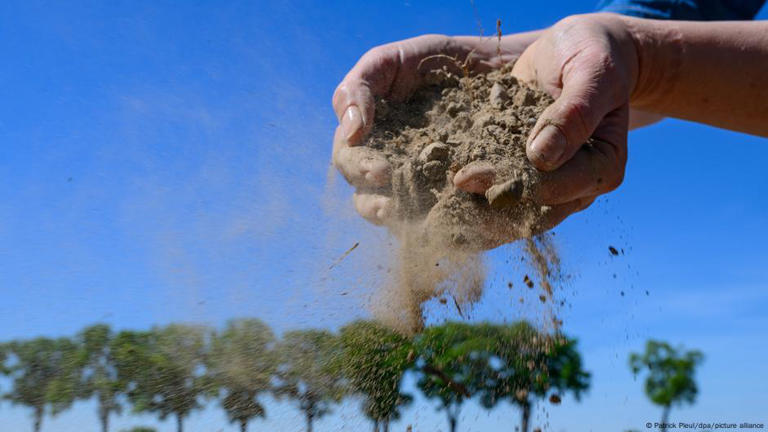
The problem is that, as climate change advances, this will change. It is predicted that we will need up to four times as much water in order to grow food crops by the end of the century — because less rain will fall, and also because the hotter it gets, the faster water evaporates. "In other words, we can no longer assume that there will be enough water to cover all our needs," says Borchardt.
Как мы можем экономить воду?
If periods of drought are going to be more and more frequent, who will be able to save water in future, and how? "The most important thing is water retention on land," says Bernd Kirschbaum. One way of retaining water is by allowing rivers, woods and meadows to take up more space.
"A river with a meandering course takes up more water when it rains and retreats when it's dry, is much better able to hold the water in the landscape," explains the environmentalist Verena Graichen. In urban areas, unsealing and greening surfaces can help water drain into the ground.
Kirschbaum thinks there is also considerable potential for businesses to save water. "Rainwater can be collected on large operating areas and roofs. It can be treated by passing it through specific filters, then reused in technical processes as process water. The same can be done with the wastewater that these companies produce."
Graichen also suggests that the agriculture sector should invest in drip irrigation and drought-resistant plants: "Chickpeas and lentils can cope with less water than you need for berries."
Эта статья переведена с немецкого.
Author: Katharina Schantz