


|
От отходов к «суперфуду»: диетологи из Гонконга превращают кухонные отходы в полезный источник белка для семей с низким доходом
|
В общем жилом помещении, спрятанном на верхнем этаже здания рынка Цуен Вань, группа женщин собралась на просторной, хорошо оборудованной кухне. Они опробовали несколько рецептов под руководством двух зарегистрированных диетологов и горстки обученных добровольцев.
От омлета и кимбапа — корейских рисовых булочек из морских водорослей — до овсяного печенья и банановых блинчиков — все эти домашние, непритязательные блюда содержали рассыпчатый, но влажный ингредиент, который женщины наливали из серебристых пакетиков размером с ладонь без этикетки.

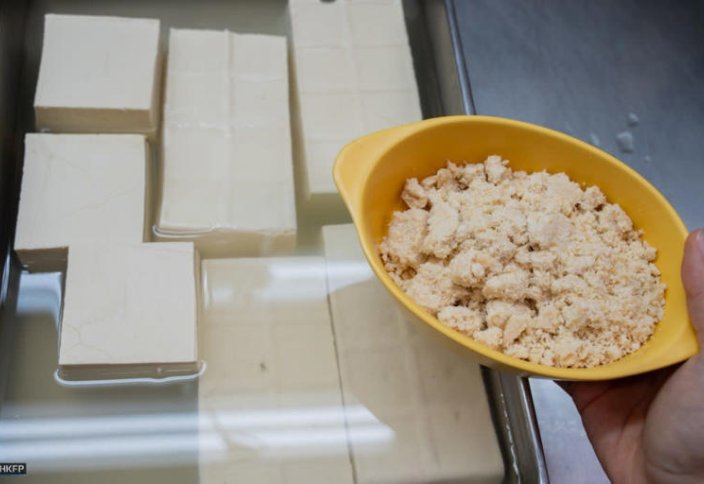
Кремово-бежевый ингредиент – соевая мякоть – был центральным элементом практического семинара. Также известный как осадок тофу, или окара по-японски, это твердые остатки от фильтрации соевого пюре во время производства соевого молока и тофу.
Семинар, разработанный и проведенный диетологами Джойс Чан и Ханной Вонг, является частью пилотной программы под названием «Проект Окара» на английском языке. Его китайское название переводится как «Проект отбросов тофу» — игра слов с термином, придуманным премьер-министром Китая Чжу Жунцзи для описания некачественных строительных работ, а затем популяризированным китайскими пользователями сети после того, как во время землетрясения в провинции Сычуань в 2008 году рухнули наспех.
Тем не менее, нет ничего хуже в настоящей муге из тофу. «Сегодня мы хотим показать вам, как превратить то, что мы обычно считаем кухонными отходами, в «суперпродукт», — сказал Пуй, недавний выпускник университета в области продовольствия и питания.
Пуй, которая раскрыла только свое имя из соображений конфиденциальности, помогла провести брифинг в тот день после того, как Чан и Вонг обучили ее в качестве посла сообщества.
С каждым слайдом, отображаемым на экране, Пуи объяснял на повседневном языке множество малоизвестных питательных преимуществ этого распространенного побочного продукта сои, от его богатого белком и клетчаткой профиля до низкого гликемического индекса и минимального количества насыщенных жиров.
Все участвующие женщины были жителями квартиры, в основном китайцами с материка, которые недавно иммигрировали в Гонконг, чтобы заботиться о своих мужьях и детях. Они находят радость в расширенном жилом пространстве, находящемся в ведении благотворительной организации Caritas, где они могут готовить, делиться едой, стирать, заводить друзей и наслаждаться кратковременной передышкой от своих обязанностей по уходу.

Food insecurity remains a pressing issue in some of Hong Kong’s poorest districts, where cost and substandard living conditions prevent many low-income residents from accessing adequate, nutritious meals.
In 2024, for instance, asurvey conducted by the Hong Kong charity Food Grace found that around 44 per cent of low-income residents in Kwai Tsing and Sham Shui Po, two of the city’s poorest and most densely populated areas, had gone hungry in the previous six months, with one-third regularly skipping meals to cut costs.
Over 46 per cent said they didn’t get enough nutrients daily, mainly because healthy food was too expensive.
Two University of Hong Kong scholars wrote in 2023 that fresh pork in Hong Kong was around four times more expensive than in Shenzhen.
Hong Kong was also ranked as the second most expensive market for chicken fillet across the Asia-Pacific region, with the average price per kilogramme more than 40 per cent above the regional average.
Apart from soaring food prices, many surveyed by Food Grace also cited the lack of proper cooking facilities in inadequate housing units as a major barrier to preparing balanced meals.

With these challenges in mind, Chan and Wong designed a pilot programme to cater specifically to underserved communities, drawing on their experience providing dietary consultation services to at-risk groups managing chronic conditions such as prediabetes and hypertension.
“In our work with subdivided flat residents and the elderly, I often hear people say how expensive meat is, or how difficult it is for older adults to chew and swallow it,” Chan said in Cantonese.
These encounters prompted her to think about alternative ingredients that could help make up for the protein deficiencies without adding to their financial burden.
Богатая питательными веществами, недорогая альтернатива
The idea began to take shape during Chan’s temple stay at Japan’s famed Mount Koya in early 2024. She was served a vegetarian side dish made from spinach mixed with okara, a common meat substitute used in many Japanese recipes. Around the same time, public debate in Hong Kong intensified over the government’s now-delayed municipal solid waste charging scheme.
“Everything is aligned,” said Chan. “It gave me the idea to repurpose a protein source and make it affordable.”

She later teamed up with Wong, and together theysecured a HK$100,000 grant from the Hong Kong government’s Social Innovation and Entrepreneurship Development Fund to launch the Okara Project, promoting recycled soy pulp as a low-cost, nutritious protein source for low-income households.
Thanks to its well-documented nutritional benefits and vegan-friendly versatility in cooking, interest in soy pulp is growing among international food manufacturers. The global okara market was valued at US$2.68 billion (HK$21 billion) in 2024 and is poised to reach US$3.2 billion (HK$25.1 billion) by 2030, according to a recent market analysis.
In countries such as Germany and the US, companies are incorporating soy pulp flour into baked goods, while researchers in Singapore have developed a probiotic drink made from okara that boasts a longer shelf life without the need for refrigeration.
In contrast, soy pulp is largely treated as food waste in Hong Kong and is rarely featured in local cuisines. And while it has traditionally been used as animal feed or fertiliser – and more recently repurposed into products like cat litter or mushroom-growing mediums – Chan and Wong’s initiative may be the city’s first to tap into its potential as a nutritious source to help address food insecurity.
“I didn’t realise you could make so many delicious dishes out of soy pulp,” said Xiaoyun, a full-time caregiver and mother who participated in the workshop. She, too, declined to give her full name.

“I used to make soy milk at home from time to time, but we usually just threw the soy pulp away without giving it much thought,” she said in Mandarin.
After relocating to Hong Kong from Fujian province about a year ago, Xiaoyun met other immigrant women like herself at the Caritas-run shared space and bonded through group activities, like cooking sessions organised by Chan and Wong.
“This gives me a feeling of being at home,” she added, describing the experience as a welcome break from the often “depressing” reality of staying in their cramped living quarters all day.
Низкое воздействие на окружающую среду
To make their project sustainable, Chan knew early on that she wanted to source the soy pulp locally, meeting the community nearby. Proximity to the source became a key priority for the project’s logistical planning. She specifically wanted to pilot the project using Caritas’ communal space as the venue, with the wet market situated on the building’s ground floor.
In Tsuen Wan Market, she managed to meet the owner of a tofu stall, who agreed to give away the otherwise discarded soy pulp for free. Her team then shipped the ingredient to a food factory, where it underwent ultra-high temperature sterilisation before being packaged in sealed sachets, ready to be distributed to community members participating in their cooking workshops.
Another mission of their project is to raise awareness of how plant-based diets can be beneficial not only to human health but also to the planet.

“Producing a kilo of plant-based food gives off around 0.3 to 4 kilos of carbon, while a kilo of beef can release as much as 60 kilos” of carbon, Pui told the participants in the briefing session in Cantonese, as she explained food’s environmental footprint.
Apart from reducing food waste by repurposing soy pulp, they could also help reduce environmental impact one food item at a time by eating more sustainably, said Pui.
Experts previously estimated that globally, switching to plant-based diets could shrink the amount of land used for food by 76 per cent and cut food-related greenhouse gas emissions nearly in half.
However, for low-income communities in Hong Kong, cost remains the primary factor in choosing food, according to the same survey by Food Grace. Fewer than one in three respondents considered sustainability or environmental impact in their food choices.
For Chan, food sustainability has always been integral to her vision for the project. She chose soy pulp precisely because it’s “affordable,” “sustainable,” and simple to use in home cooking.
Расширение возможностей сообщества
Chan and Wong’s vision also extends beyond cooking workshops and community education. As part of their pilot programme, they’ve trained around 30 community nutrition ambassadors – 10 of whom are now active team members.
“Most of them are retired women who are passionate about cooking and eager to give back to their communities,” said Chan.

After completing the training, the ambassadors went on to brainstorm recipes, help co-lead workshops, and gradually take on bigger roles in spreading the project’s message, while also receiving a paid wage for their efforts.
For some, the experience has been transformative. “I usually get anxious when speaking in front of people,” said Jay, a retired teacher who trained to become an ambassador last year.
Jay, who did not want to give her surname, was co-leading a session with Pui that day.
Speaking to people from diverse backgrounds and varying levels of understanding was vastly different from teaching children, Jay explained. “But they always encourage me and praise my efforts, which helps me keep going.”
The project has also drawn interest from young, aspiring professionals like Pui, who hope to promote healthy and environmentally conscious diets.
“I was originally more focused on sports nutrition,” Pui said. “But after engaging with these communities, I realised I could do more by helping prevent chronic diseases through modifying their diet, especially since many people don’t have access to reliable nutrition advice.”
Meanwhile, Chan is looking to scale up their community-driven model and turn soy pulp into an accessible and commercially viable protein alternative.

“At our talks, people became curious about where they could get soy pulp near them so they could bring it home and try the recipes themselves,” the dietitian said.
Having already developed recipes and conducted training sessions, the key question now is how to help communities source soy pulp more consistently and on a larger scale.
“Imagine a space where all the trainings and soy pulp exchanges take place under one roof,” said Chan, outlining her vision for a community hub dedicated to sharing soy pulp recipes and knowledge.
She also hopes to create an online platform to help people find nearby locations where they can collect soy pulp, either for free or at a low cost.
“Something like a WhatsApp group or a Google Maps listing,” Chan said.
Hong Kong Free Press