





|
После многих лет санкций США, как обстоят дела в экономике Синьцзяна?
|
Китайские ученые говорят, что эти меры привели к потере рабочих мест и сокращению прибыли для некоторых компаний, но регион демонстрирует устойчивость
Китайские ученые раскритиковали санкции США в отношении Синьцзяна, заявив, что их исследование показало, что эти меры привели к долгосрочному экономическому ущербу, включая потерю рабочих мест.
Выводы, представленные на академическом семинаре в Гонконге в прошлом месяце, стали одной из первых агрегированных оценок воздействия санкций США, введенных в отношении китайских компаний в связи с предполагаемыми нарушениями прав человека в Синьцзян-Уйгурском автономном районе на западе страны.
Пекин отверг эти обвинения и осудил санкции как «направленные на создание безработицы» в регионе.
У вас есть вопросы о самых актуальных темах и тенденциях со всего мира? Получите ответы на эти вопросы с помощью SCMP Knowledge, нашей новой платформы тщательно подобранного контента с объяснениями, часто задаваемыми вопросами, анализами и инфографикой, предоставленной нашей отмеченной наградами командой.
Санкции, впервые введенные в 2019 году во время первого срока президента США Дональда Трампа, нацелены на растущий список компаний, базирующихся в Синьцзяне.
Этот список продолжал расти при администрации бывшего президента США Джо Байдена, особенно после того, как в 2021 году вступил в силу Закон США о защите принудительного труда уйгуров.
С тех пор в общей сложности 144 китайские компании, экспортирующие одежду, критически важные минералы, электронику, химикаты и сталь, были добавлены в список организаций, что фактически запретило им входить на рынок США, согласно данным Министерства внутренней безопасности США.
Список компаний охватывает китайские компании в Синьцзяне и ряде других регионов, в том числе в экспортных центрах вдоль восточного побережья.
Министерство торговли США ввело санкции против десятка китайских компаний за предполагаемые нарушения прав человека в Синьцзяне, такие как использование технологий для помощи местным органам власти в слежке за уйгурами и другими этническими меньшинствами.
В число компаний входят ведущие технологические и AI-компании, такие как Hikvision, iFlyTek и SenseTime. Американские компании не могут продавать этим фирмам технологии или комплектующие без специальной государственной лицензии.
Tuersun Aibai, associate professor at Xinjiang University's School of Journalism and Communication, told the seminar that the economic impact of the US-led sanctions on Chinese companies had become apparent in recent years and had caused local unemployment.
His findings were presented at a two-day conference co-hosted by Tsinghua University, the University of Hong Kong and the Hong Kong University of Science and Technology.
"Some Chinese companies were added to the entity list in 2020, and a considerable number of them saw their revenue and net profits drop that same year, but for some other companies, the impact had started becoming apparent by 2023," Aibai said.
But that does not mean the regional economy has collapsed. While local economic growth nearly halved to 3.2 per cent in 2022 from the previous year, it then rebounded to 6.8 per cent in 2023 and 6.1 per cent last year.
Meanwhile, Xinjiang has also invested heavily in new energy, tourism and modern agricultural technology to counter the impact of sanctions and Covid-19.
"Governments at all levels [and] state-owned enterprises are taking the initiative to shoulder responsibilities. In recruitment, they prioritise increasing recruitment from ethnic minority communities in Xinjiang by creating suitable jobs and ensuring employment opportunities," Aibai said.
"This approach helps protect labour rights while also providing an effective response to US sanctions," he said.
Aibai's studies are based on a mixture of company registration data and publicly available information.
One indicator to gauge the impact of the sanctions is the decline in the number of employees enrolled in China's social insurance schemes, as it provides a useful proxy for estimating the size of the workforce, according to Aibai.
According to Aibai, more than half of the companies included in his research saw drops in insured employees from 2021 to 2022. He collected data from 14 leading Chinese companies with operations in Xinjiang that were targeted by US sanctions.
He said the US sanctions in recent years had played "a particularly significant role" in companies' net profit decline.
For example, the number of insured employees at Hoshine Silicon Industry Corporation dropped to 1,207 in 2022 - around 16 per cent of its insured employees in 2021, which amounted to 7,636 people.
The US banned imports from the company, headquartered in the eastern province of Zhejiang, in 2021 over allegations of forced labour.
In another case, printmaker Ninestar Corporation's insured employees in 2022 dropped to 287, around 10 per cent of its number in 2021, according to data presented by Aibai.
Ninestar Corporation, based in the southern province of Guangdong, was sanctioned in 2023 over alleged human rights abuses under the US Uygur Forced Labour Protection Act.
"What we have observed is that after the US imposed sanctions, some companies saw a decline in social insurance enrolment - fewer insured employees means fewer workers. In other words, by sanctioning Xinjiang, the US is in effect creating forced unemployment in the region," Aibai said.
It is unclear whether the Xinjiang regional government collects data on local unemployment directly caused by US sanctions. No such data has been made publicly available.
But there are signs of unusual economic effects.
According to data published by the Statistics Bureau of the Xinjiang regional government, large industrial companies - meaning companies with annual business income of at least 20 million yuan (US$2.8 million) - suffered yearly profit losses from 2023 to 2025.
The losses of affected Xinjiang companies also appeared to be sharp in comparison to nationwide data published by China's National Statistics Bureau.
The profits of large industrial companies in Xinjiang fell by over 30 per cent year over year in 2023. In contrast, the profits of similar-sized companies only fell by 2.3 per cent nationwide.
The profit margins of large industrial companies in Xinjiang further dropped in 2024 by over 18 per cent, while nationwide they only declined by 3.3 per cent.
Profit margins again declined 21.5 per cent for Xinjiang companies in the first half of 2025, while nationwide it only decreased by around 2 per cent.
The statistics report published by the Xinjiang regional government did not offer an explanation for the drop in profits.
To drive economic growth, Xinjiang has planned to invest 406.9 billion yuan (US$57 billion) in big projects this year, with 70 more projects than last year.
Newly added jobs remained largely stable between 2022 and 2024, averaging around 475,600, according to local government data.
The sharpest rise was in 2023, with more than 20,000 new jobs added compared to the previous year. The number of unemployed people who later managed to find jobs grew steadily from 207,100 in 2022 to 266,800 in 2024.
Early on into Washington's Xinjiang sanctions, Chinese officials warned they would have economic impacts.
Former foreign vice-minister Le Yucheng said in 2021 that American sanctions on Xinjiang companies deliberately created "forced unemployment" and "forced poverty" in the region, according to a report published by the foreign ministry in 2021.
"Sanctions not only harm the interests of these companies, but also damage the livelihoods of ordinary people in Xinjiang ... The real intention behind Western sanctions is not to protect human rights, but to destabilise Xinjiang and contain China's development," Le said in the report.
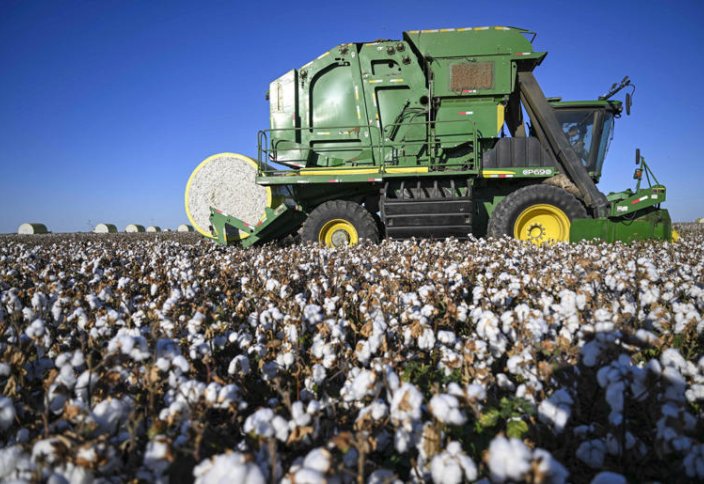
Xinjiang's cotton and textile industry has seen a "huge impact" from US sanctions, said Lin Fangfei, an associate professor of sociology at Xinjiang University who also attended the Hong Kong conference.
"It has also created significant difficulties for us. It has a huge impact on Xinjiang's cotton textile companies and China's cotton textile companies," Lin said.
"The US narrative of forced labour that has been constructed is extremely malicious and inconsistent with the facts," she added.
Lin has done fieldwork in Xinjiang's cotton fields for more than a decade and has also interviewed companies on the effects of US sanctions. However, due to research ethics, the data needs to be kept confidential.
The American ban on cotton products originating in Xinjiang has caused the export volume of Chinese cotton products to the US to decline by 17 per cent, and Xinjiang and other regions reliant on Chinese cotton suffered the largest losses, according to research presented at a conference at the Chinese University of Hong Kong in April.
This research was published by a team led by Jean-Francois Maystadt, senior lecturer in economics at Lancaster University, together with researchers from KU Leuven and the World Bank.
The EU has not imposed any sanctions against Chinese cotton products, but the study also identified "significant and negative" indirect effects on China's cotton exports to the European Union as European companies may be worried about reputational damage if they use cotton products from China.
According to the latest data released by US Customs and Border Protection in July, the value of shipments originating from China and flagged under the Uygur Forced Labour Prevention Act has dropped by more than 85 per cent from its peak in 2023.
In 2023, shipments flagged by US customs were valued at about US$240 million, compared with just US$35.1 million to date this year.
"The US legislation on Xinjiang has effectively excluded a specific region and a specific ethnic group from the international supply chain - this is both unfair and unreasonable," said Wang Jiang, deputy dean of the Institute of China's Borderland Studies at Zhejiang Normal University.
"Such measures inevitably affect the development of that community and affect their sources of income," Wang added.
Since 2019, the US has introduced two major pieces of legislation targeting Xinjiang: the Uygur Human Rights Policy Act, signed into law in 2020, and the Uygur Forced Labour Prevention Act signed into law in 2021.
It has also introduced other bills to refine details on customs inspections and corporate compliance requirements.
Early this year, US lawmakers proposed the No Dollars to Uygur Forced Labour Act. The legislation, if passed, would prohibit the Department of State and the US Agency for International Development from using funds on contracts that knowingly use products from Xinjiang or goods produced by companies with ties to alleged forced labour.
Wang said there had been little research on evaluating the long-term collateral damage in Xinjiang caused by the US sanctions, partly due to difficulties in obtaining data.
Xinjiang-based scholars also said the US sanctions were driven less by human rights concerns and more by political motivations.
The US sanctions aimed to pressure Chinese producers to cut ties with Xinjiang cotton, boost US cotton's dominance in global markets, and make China's textile industry dependent on US supplies, according to Lin.
"For US allies, the Xinjiang sanction also carries significant costs, but at its core, this process reflects Washington's effort to secure control over the international political and economic order - not because of what China is, but because the US insists on holding that control," she said.
This article originally appeared on the South China Morning Post (www.scmp.com), the leading news media reporting on China and Asia.
Copyright (c) 2025. South China Morning Post Publishers Ltd. All rights reserved.